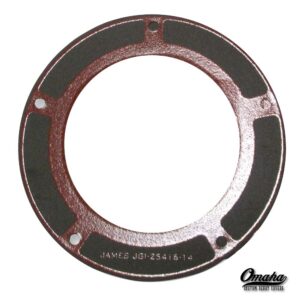
There was a thread on HD Forums recently where a guy from Ireland was having trouble with a leaky derby cover on his late model Softail. What was weird was that he replaced the original part with a genuine HD accessory part. Should have worked, right? I mean, there’s a lot of cheap aftermarket junk out there, but you figure you’re getting stuff that fits when you buy direct from HD.
Having spent more time than I care to think about dealing with the geometry of the various versions of derby covers HD has made over the years, I thought I’d share some of the things that make the Milwaukee 8 Softail derby covers unique.
The Other Kinds of Derby Covers
Starting with the three-hole type they put on Shovelheads and Evos, through the five-hole type they put on Twin Cams, the four-hole and six-hole versions for Sportsters, and, last, the big (7.75” dia) five-hole they put on the Milwaukee 8 touring models, a bunch of things changed. But two things stayed constant: They all use ¼-20 mounting bolts, and the gasket surface on the outer primary and the corresponding surface on the derby cover mash up hard against each other.
Milwaukee Changes Things Up
That changed with the Milwaukee 8 Softails. Nevermind that they went to 10-24 mounting bolts. The interesting part is that the design requires an air gap between the gasket surface on the derby cover and the corresponding surface on the outer primary.
Note that all this applies to 2019 and newer Softails. 2018 models were the crossover year. They got the new Milwaukee 8 engine, but retained the previous style outer primary and derby cover (7.25″ diameter). The exception was the 2018 FLSB Sport Glide. That was the first model to receive this new (6.4″ dia) outer primary and derby cover.
Here’s how it works. I have an outer primary that I use for testing. The mounting location for the derby cover looks like this:
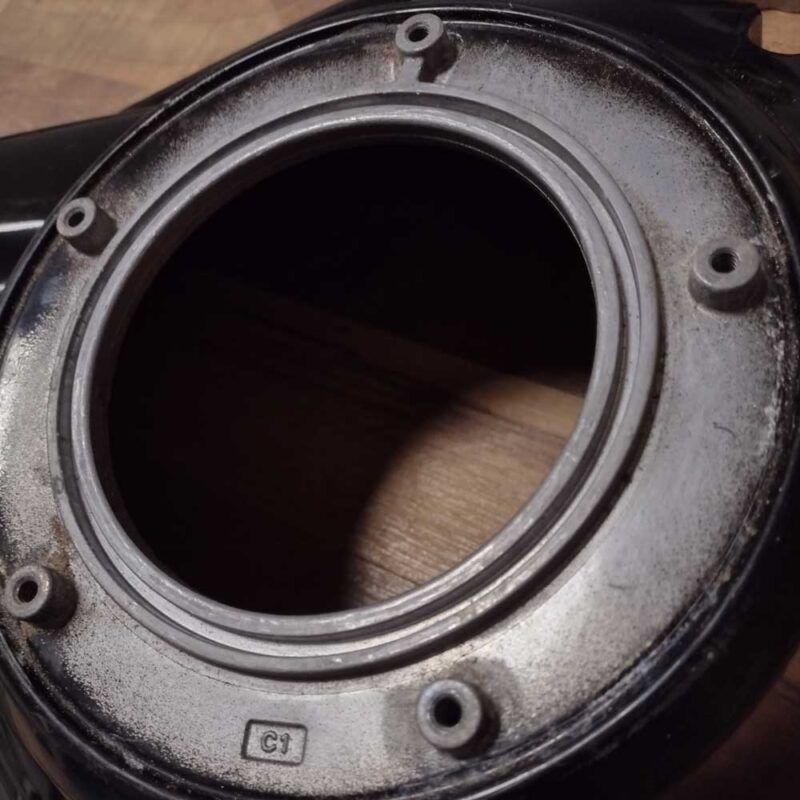
Those standoffs (where the mounting bolts install) are unique to the M8 Softails. No other HD has anything like that design. The back side of the derby cover has pockets that fit around those standoffs:
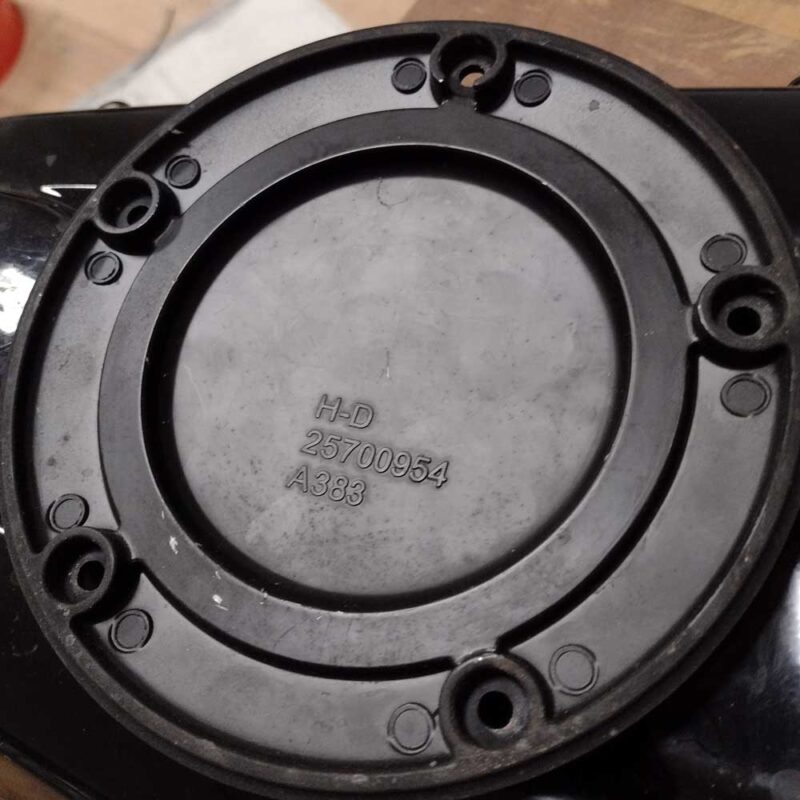
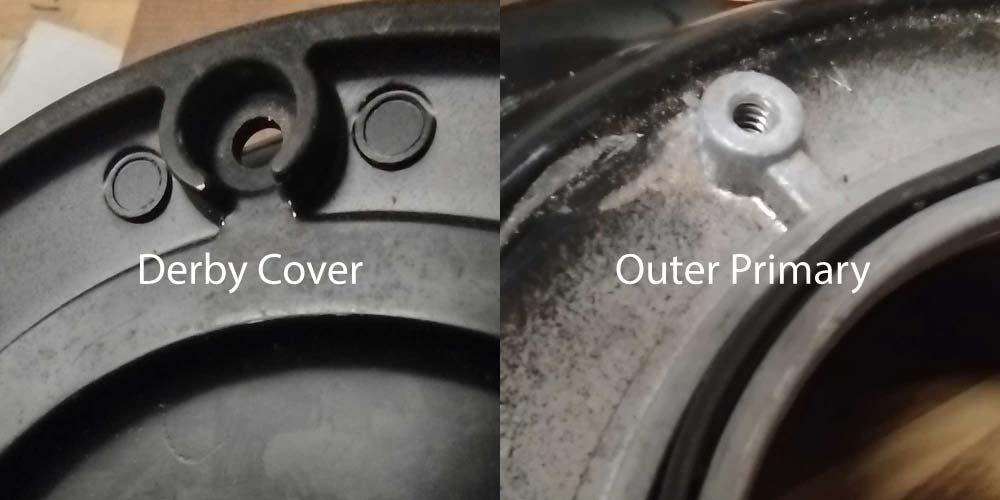
That also gets to the other thing HD changed with the M8 Softail. They decided to “poka-yoke” the design, and put a notch on the pocket in the 12 o’clock position so you can’t put the cover on wrong:
Here’s my outer primary with a genuine HD derby cover installed (my custom derby covers are cooler, but the point here is to show the geometry as it comes from HD):
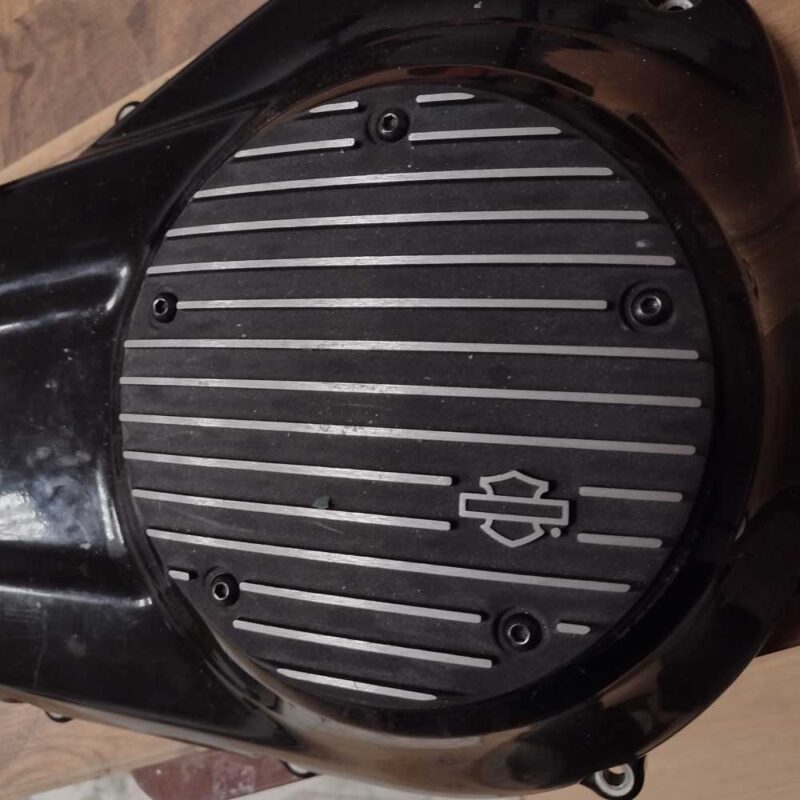
If you flip it over and measure, you’ll find that there is an air gap between the outer primary and the derby cover, all the way around:
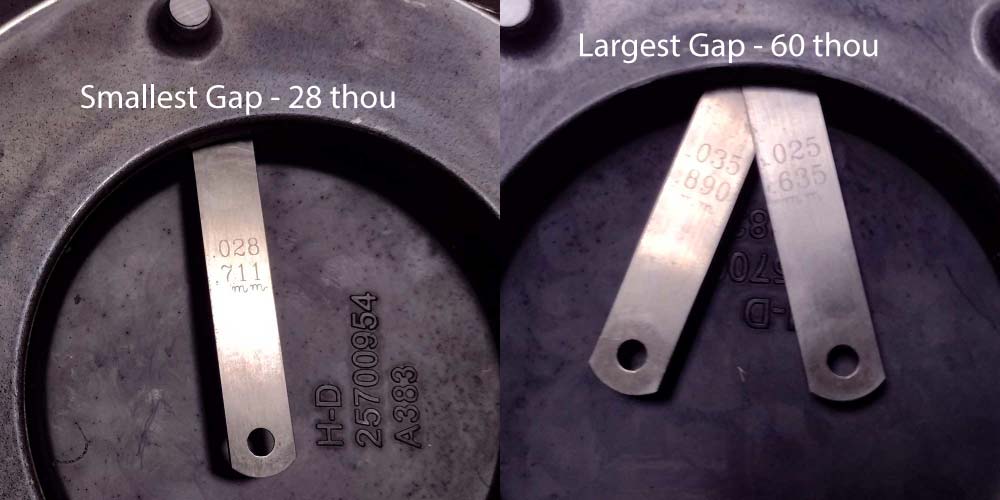
So not only is there an air gap, the gap varies quite a bit. Which makes sense. These parts are all die cast, and they don’t machine the mating surfaces, so there is going to be a lot of variation due to the inherent nature of metal casting. There’s nothing special about the numbers I got on this test. Different units will test differently, but they are always in that same ballpark.
With HD’s design, the only points of hard contact between the outer primary and the derby cover are where the standoffs on the outer primary meet the bottom of the pockets on the derby cover. Not only is there an air gap on the gasket area, the outer rim of the derby cover floats above the outer primary as well.
This is a cutaway view I pulled from my CAD system:

So Why Do They Leak?
So back to the guy from Ireland who was having trouble with leakage. What I’ve found is that that air gap is the key. If it is too large and the gasket can’t reach the derby cover, obviously you’re going to have a leak. But it will also leak if the gap is too narrow, and in particular will leak if the derby cover makes hard contact with the outer primary at some point along the gasket area. My suspicion is that in his case, through plain bad luck, the natural dimensional variation in metal casting caused him to end up with a derby cover/outer primary combination that just happened to each be warped in just the wrong spot that they made hard contact.
How To Test Yours
I wish I had an easy way to test this, but the way I see it, if you’ve got a leaking derby cover problem and you really want to know what’s what, you have to pull the outer primary off the bike. That’s not a horrible task, but it’s not nothing either.
To test your setup:
- Remove your derby cover
- Remove the outer primary from the bike
- Pull the gasket out of the outer primary
- Re-install the derby cover (without the gasket)
- Using feeler gauges, measure around the circumference from the inside, where the derby cover meets the outer primary.
- In my experience, you want to have at least 0.015″ all the way around, but you don’t want any spot to be greater than 0.080″. I can’t say I’ve done exhaustive testing to arrive at those numbers, but they should be close. I can say with confidence that if you have a spot where you can’t get even your thinnest feeler gauge into the gap, it’s too tight.
Making Sure It Seals
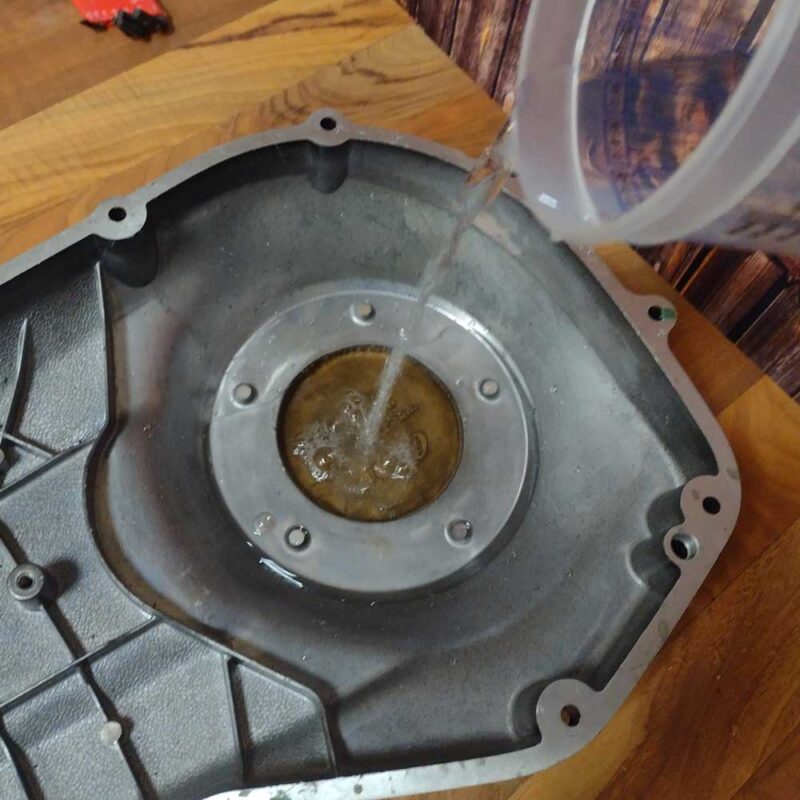
From time to time, I tweak the CNC program I use to machine my custom derby covers. Whenever I do, as a last check, I “water test” one of the new ones, just to make sure everything is correct. Feeler gauges are fine, but at the end of the day, what we are looking for is a water-tight (or, oil-tight, if you will) seal. Water testing these removes any doubt. If things are as they should be, the seal will hold water indefinitely without dripping onto the table.
What’s The Point of This Design?
I’ve asked myself that question ever since I saw my first Milwaukee 8 Softail derby cover. What is the purpose to this design? What problem were they trying to solve?
The answer is I have no idea. It’s not my place to say this is a “bad” design, but it does strike me as overly complicated compared to the engineering requirements. I put a video on my YouTube channel talking about this design, and invited the engineers from Harley-Davidson to give me a call. So far, no calls. I’m not surprised (or disappointed) by that. I’m sure they have better things to do. Still, I would be interested to know (and happy to share) what their logic is behind this setup.
Get A Custom Derby Cover
All of my Harley Davidson custom derby cover designs are available for Milwaukee 8 Softail models. Look around, and find one you like! Better still, shoot me an email at jeff@omahaderbycovers.com and let’s have a conversation about coming up with a unique, personalized design just for you. You know you deserve it!