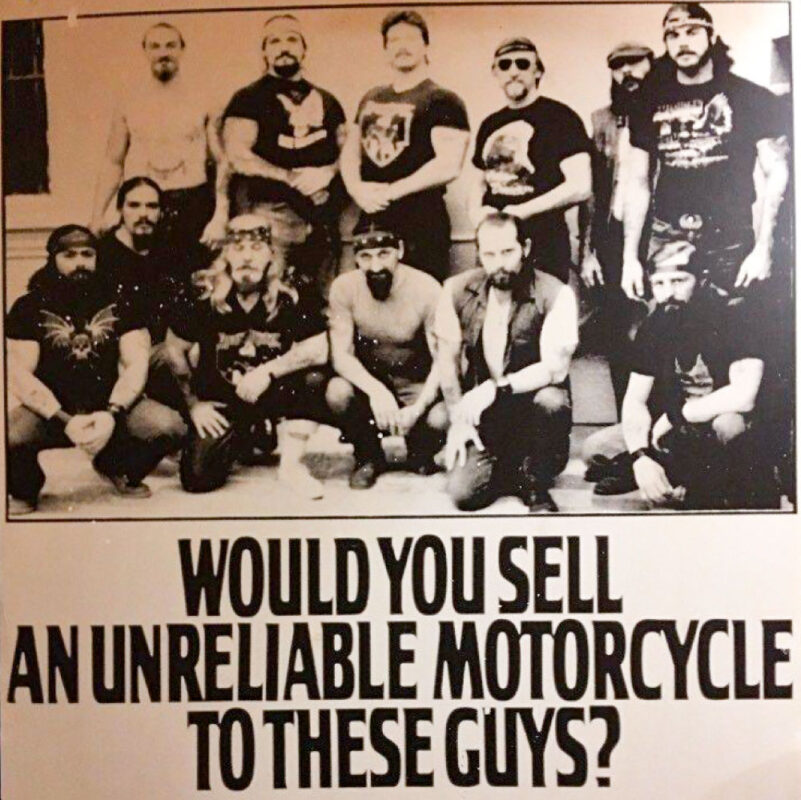
I first saw the ad shown above in billboard form back when I was living in Green Bay, Wisconsin around 1987 or so.
When I think back on all the cars and bikes I’ve had over the years, the ones that really stand out, the ones that really meant something to me, were also the most demanding.
I got stranded in the middle of South Dakota in a ’68 Bug one time. Hot as hell that day. Spent three hours dicking with the carburetor. Finally got it running well enough to get me into Rapid City. That car was tough to love, but you had to love it. And in the process, you could almost convince yourself that it loved you back.
That’s the kind of connection between rider and machine that created the “Harley mystique”. You’d see these guys with their old crap knuckles and pans and shovels and as much trouble as they gave them, it also created a relationship with them. A bond. You couldn’t live with a bike like that without it soaking into your heart. If you weren’t the kind of person wired for that kind of relationship with a machine, you’d just move on.
For those that had the wiring, those that stayed, it ran deep. They knew every gear and bolt on those machines. They felt its moods. They cared for it when it needed caring for, and they rode it like the hammers of hell when they had to. That was the connection. Rider and machine, mutually dependent. There’s beauty in that.
Those riders, diverse as they were and are, created a unique and distinctive sub-culture that captured the imagination. There was an honesty to how they lived. And independence. And self-reliance. And desperation. And authenticity. And danger. Always there was danger. Those things caused a visceral appeal for everyone else.
The MoCo figured that out, and figured out that the way to sell more bikes was to more people was to put that culture in a bottle and sell it too. “Would you sell an unreliable motorcycle to these guys?” We got the message. It wasn’t about the bike. It was about the guys. You could be one of those guys. At least a little. When you wanted to. All the honesty and independence and self-reliance and desperation and authenticity and danger, it was all just a 48 easy payments away.
And the bikes truly did get better. So much better. And the new consumers came. Thousands upon thousands of them every year.
But the new consumers didn’t have the time or inclination or heart to bond with the machine like the old guys. They didn’t need to. Don’t need to. The machine no longer demands it. The machine is now an appliance. Treat it like your dishwasher. Use it when you need it. Forget about it when you don’t. Then use it again. It will be there.
Nice. That’s a better machine. That’s a quality machine.
Or is it? Much has been gained, but something has also been lost. The satisfaction of knowing that your machine depends on you and that you are competent to take care of it. Connection. Beauty. There’s something there.
Modern motorcycles are marvels of engineering. HD. Yamazuki. Honda. Doesn’t really matter. They are all amazing. But they all, every one of them, deliver a fundamentally different kind of rider experience than those that formed the foundation of the biker culture that the MoCo is selling. That’s the irony. The better the bikes get, the more the old style of bike to rider relationship fades.
Nothing wrong with that. The guy who spends two times on his new HD what my father spent for his first house expects a machine that works. Can you blame him?
I can’t. Any more than I can blame the old-school guy who looks at these complaints and says “you just gotta give it some love, man”.